
Clinical documentation,
backed by intelligence.
DraftIQ turns structured clinical inputs into a first draft you can review, refine, and sign off. Built for communication and swallowing professionals. Every clinical decision stays with the clinician.
Communication and swallowing clinicians spend hours documenting work no software was designed to support.
Templates organize information. Generic AI generates text. Neither understands rehabilitation documentation.
Blank page, again.
BurdenThe session is done. The notes are in your head. Now comes the part nobody enjoys: writing a full report from a blank page.
Report after report. The same cognitive work that never gets easier.
Inconsistent every time.
ConsistencyYour last report reads differently from the one before it. The structure shifts. The phrasing changes. Section order varies.
Without a consistent structure, every report is a judgment call. Supervisors flag it. You rewrite it. The cycle repeats.
The terminology trap.
LanguageYou know what you observed. Translating clinical observations into formal written language, accurately and consistently, is a skill in itself.
Students struggle. Even senior clinicians slow down. The gap between clinical thinking and clinical writing is real.
After hours. Again.
BurnoutReports don't get written during sessions. They get written after hours, when cognitive bandwidth is at its lowest.
Documentation is one of the top drivers of clinician burnout. The problem isn't skill. It's the tools.
This isn't a skill problem.
It's a workflow problem.
A daily reality for clinicians, students, and supervisors, not because they lack ability, but because no tool was built for the way communication and swallowing documentation actually works.
Clinical documentation,
backed by intelligence.
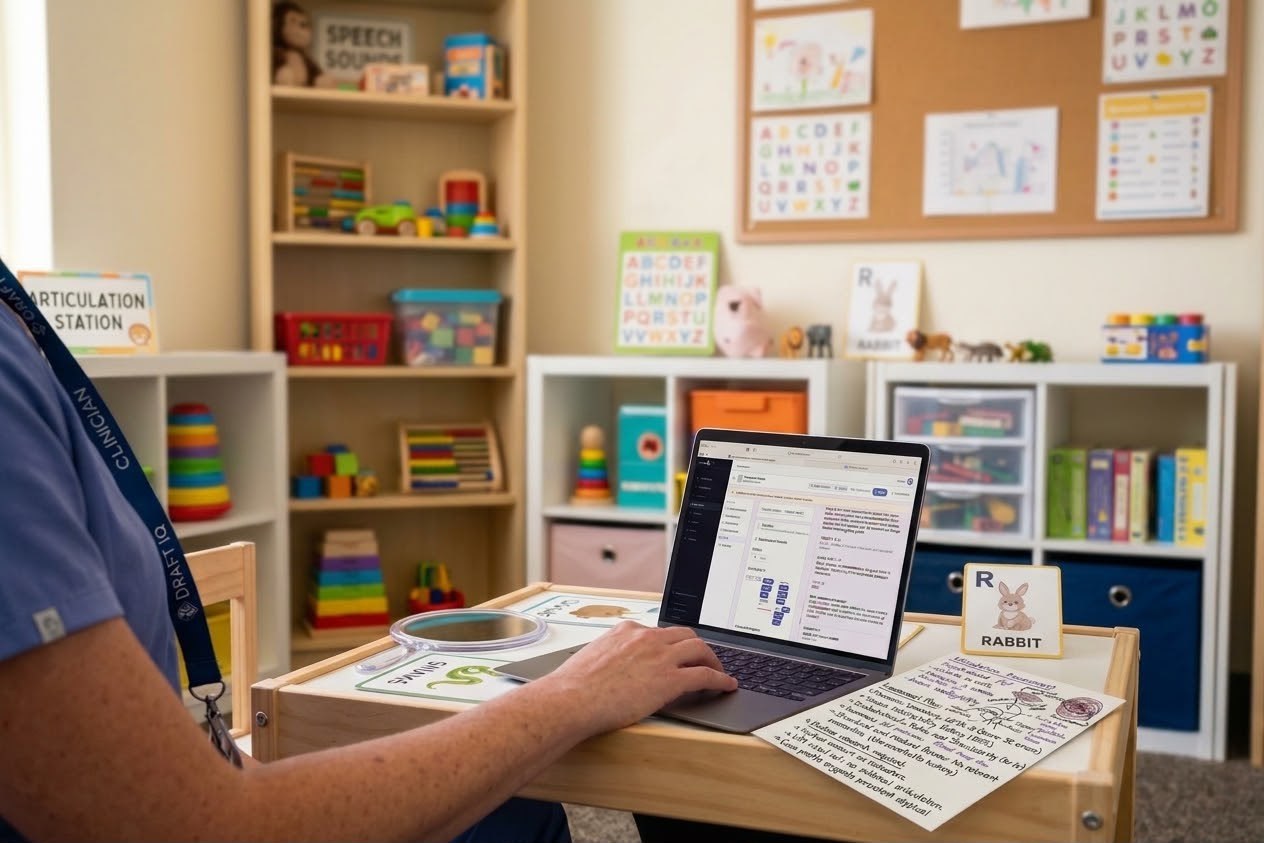
DraftIQ turns structured clinical inputs into a first draft the clinician reviews and refines. Every clinical decision stays with you. Review before finalizing.
Structured inputs.
A first draft, ready for review.
Enter what you observed. DraftIQ composes a first draft for you to review, edit, and approve.
Four steps.
One first draft.
DraftIQ composes the first draft. The clinician reviews, refines, and signs off.
Enter case details
Patient info, referral reason, and case history through structured chip-based inputs. No long-form writing.
Select structured inputs
Clinical observations, assessment findings, and rating scales — entered through guided, domain-specific chips. Every step supported by a dedicated knowledge engine.
See the draft compose
A first draft composes in real time as you enter each input. Every sentence is yours to edit.
Review before finalizing
Preview the draft. Edit any sentence. Approve, copy, or export to PDF. Every version is saved.
Built for how communication and swallowing care
actually works.
From first-year students to senior clinicians. Every role in the communication and swallowing world has a place in DraftIQ.
Live today: Articulation Diagnostic and SOAP. Language, voice, fluency, and dysphagia workflows in development.
Communication and Swallowing Clinicians
Structured workflows and a knowledge engine that compose standardized report drafts. Every clinical decision stays yours.
- ✓Structured workflows across communication and swallowing domains
- ✓Live-composing report drafts from structured clinical inputs
- ✓Diagnostic and SOAP workflow with live preview and autosave
- ✓Saved report versions across every draft
- ✓Consistent report structure, every clinician, every domain
Students and Interns
Learn documentation the way it's actually done. Draft the report. Send for supervisor review. Finalize after cosign.
- ✓Author reports supervisors can review before finalization
- ✓Structured workflow teaches the report shape
- ✓Version history preserves the full drafting process
- ✓Guided chip-based inputs, not blank pages
Clinical Supervisors
Review, approve, and cosign student-authored reports. Every version and supervisor decision recorded.
- ✓Cosign workflow built into every student report
- ✓Saved versions of every draft, preserved for traceability
- ✓One consistent report shape across your team
- ✓Supervisor decisions recorded on every cosign

Less time documenting.
More time for care.
Early Access is application-based. We onboard a limited number of clinicians and clinics each cycle so we can support each partner properly.
Application-based · Limited onboarding
- Early Access to Articulation Diagnostic and SOAP workflows
- Onboarding support from the DraftIQ team
- Priority input on what we build next
- A direct line to the team for feedback and requests
Join Early Access
Requests reviewed within a few working days.